 PLOT LUCK
Atomic Testing Era — 1951
A Las Vegas chapter of the Cold War still echoes far beyond Nevada.
- History
- 1951
- Location
- Atomic Museum, 755 E. Flamingo Road, Las Vegas
- In Plot Luck
- Exterior/public approach marker. Confirm plot access and follow posted restrictions.
Is it worth visiting?
- Access / admission
- Ticketed indoor museum. Check current hours, discounts and ticket options.
- Suggested time
- Allow roughly 1–2 hours for the exhibits.
What to expect
This is one of the stronger indoor history stops in Las Vegas: artifacts from the nuclear testing era, scientific context, and displays that connect the Nevada desert to a much bigger national story. Unlike a roadside marker, there is a collection you can explore at your own pace.
Before you go
Go here for the actual museum—not the distant former test-site grounds. If you want a guided visit, contact the museum in advance. The museum lists docent-led tours by advance arrangement.
Check official visitor information and updates ↗
PlotLuck editorial visit rating (not a Google review score). Conditions, access and fees may change. Information checked October 17, 2026; verify with the venue before traveling.
An atomic age in Southern Nevada
Nevada became one of the nation’s central nuclear-testing landscapes during the Cold War. The first test at the Nevada Test Site took place on January 27, 1951. The site, now known as the Nevada National Security Site, lies far from the Strip, but its presence influenced jobs, science, politics and public culture throughout the region.
Atmospheric explosions became part of the era’s visual imagination. Accounts of mushroom clouds visible from the Las Vegas area may sound surreal now; at the time, they were tied to secrecy, military strategy and the race for nuclear power.
Science, national security and difficult consequences
The history is not simply a story of spectacular explosions. Nuclear testing involved many scientists, soldiers, construction workers and nearby communities. Tests yielded measurements used to develop weapons and understand effects, while also creating serious questions about radiation exposure, environmental damage and government responsibility.
Families and communities downwind have described long-running concerns about health and fallout. A responsible account of Nevada’s Atomic Age has room for technical achievement, political debate and the people who experienced its costs.
Why a museum in Las Vegas?
The Atomic Museum at 755 E. Flamingo Road preserves objects, photographs, instruments and personal accounts related to the national nuclear-testing program. Its exhibits include scientific hardware and artifacts of Cold War civil defense. The museum also helps visitors connect nuclear research to the changing political and cultural climate of the twentieth century.
It is important to distinguish the museum from the original test site: a visit to this museum is a visit to historical interpretation, not to a live or historic detonation location.
Atomic imagery and the tourist city
Las Vegas became associated with atomic-era imagery in part because the nuclear age overlapped with the growth of roadside tourism, neon signs and entertainment. Atomic-themed souvenirs and promotion reflected the era’s contradictions: spectacle and anxiety, scientific pride and uncertainty.
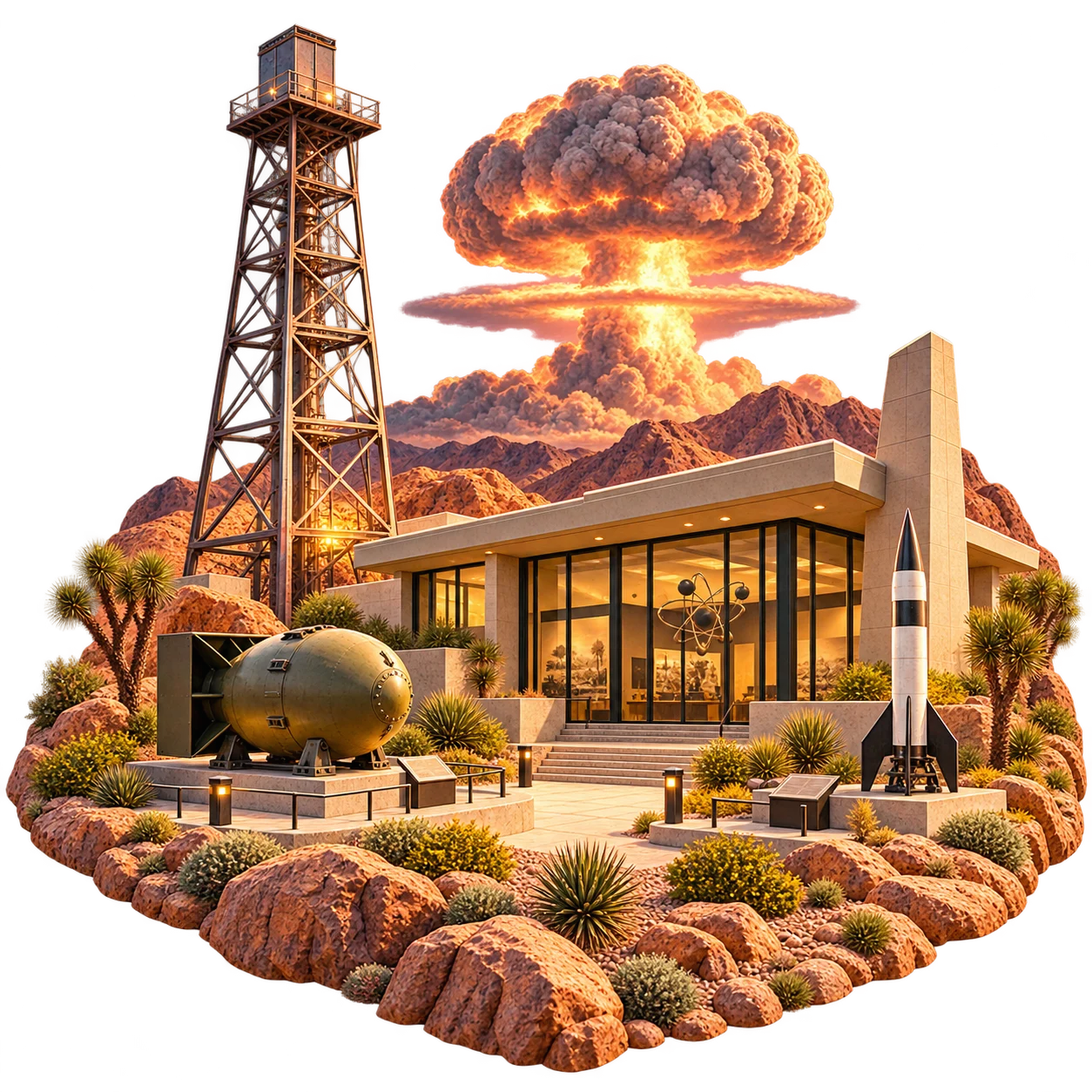
Plot Luck’s illustration uses a stylized mushroom cloud and historical instrumentation to represent the subject. It is symbolic artwork, not a view of an explosion happening at the museum or an invitation to approach restricted testing facilities.
Why it belongs in Plot Luck
This discovery adds science, labor, politics and environmental history to the Las Vegas map. The player marker is placed near the museum’s publicly accessible outside approach, so the game does not require buying an admission ticket. Current operating information and museum programs are available on its official website.
Eligible live Real GPS players can open the museum’s historical overview. Returning to Plot Luck can grant the standard daily landmark reward, subject to the same 50-token cap that governs the other landmarks and Duck Song Easter eggs.
Sources & further reading
Artwork is an original stylized interpretation, not a measured reconstruction. The Plot Luck GPS plot represents a historical-site approach and must be confirmed safe and publicly accessible before field rollout.