 PLOT LUCK
Hoover Dam — 1935
In Black Canyon, a Depression-era construction project reshaped the Colorado River and helped make the modern Southwest possible.
- Dedicated
- September 30, 1935
- Location
- Black Canyon, Colorado River, Nevada–Arizona border
- In Plot Luck
- GPS discovery at the pedestrian-accessible Nevada memorial plaza, not the dam wall.
Is it worth visiting?
- Access / admission
- Public outdoor viewpoints; optional ticketed Visitor Center and tours. Parking may have a fee.
- Suggested time
- Allow roughly 1–3 hours depending on viewpoints and tours.
What to expect
The curved concrete wall, Black Canyon setting and Colorado River scenery make this a genuinely spectacular trip, even without a formal tour. A guided visit can add the engineering story that is harder to appreciate from photographs alone.
Before you go
Expect vehicle security screening, desert sun and walking. Some tours sell out; check current Bureau of Reclamation information and tour availability before traveling. Use designated pedestrian areas.
Check official visitor information and updates ↗
PlotLuck editorial visit rating (not a Google review score). Conditions, access and fees may change. Information checked October 17, 2026; verify with the venue before traveling.
A concrete wall that changed a region
Hoover Dam is not inside the Las Vegas Strip, and that is exactly why it belongs in a broader history of Las Vegas. About thirty miles southeast of the city, the Colorado River enters Black Canyon, where the dam closes a narrow gap between the rocky walls of Nevada and Arizona. It is an arch-gravity structure: its massive concrete body uses both its own weight and the canyon walls to resist the force of water stored behind it.
The reservoir became Lake Mead, named for Elwood Mead, a leader of the Bureau of Reclamation. The same project helped regulate the river, produce hydroelectricity and support water delivery to communities and agriculture across the region. For a city often reduced to signs and hotel towers, this is a reminder that Las Vegas grew within a much larger network of engineering, transportation and water infrastructure.
Building the dam during the Great Depression
Work began in 1931, as the Great Depression left many Americans desperate for wages. Thousands of workers came to the region. Boulder City was created to house project workers and their families, while new road, railroad and power connections supported the construction site. What visitors now see as a single enormous structure began as a succession of dangerous, coordinated tasks.
Before the concrete dam could rise, crews needed to redirect the Colorado River. Diversion tunnels were driven through the canyon rock; cofferdams isolated the construction area; the riverbed was excavated down to suitable foundations. The scale becomes more remarkable when considered against the summer heat, difficult terrain and limited machinery of the 1930s. Workers, engineers and families experienced real hardships, and fatal accidents and illnesses accompanied the work.
Construction of the main dam advanced quickly. The first concrete was placed in June 1933; the last concrete in the dam was placed in May 1935. President Franklin D. Roosevelt dedicated the project on September 30, 1935, although installation and completion work continued into 1936. The first generating unit went into commercial operation in October 1936. Calling it a 1935 landmark marks the dedication, not the instant everything was finished.
Lake Mead, electricity and the Las Vegas connection
A dam is more than the surface visitors photograph. Hoover Dam is part of a regional system that stores and distributes water, generates electricity and serves distant communities. The powerhouse sits downstream at the foot of the great wall. Water flowing through turbines turns generators that produce electricity, and transmission infrastructure carries that power into a growing Southwest.
The project also changed the human geography of Southern Nevada. Thousands of laborers, their families and the businesses that served them made the region busier during years when work was scarce. The road and railway networks that connected construction sites to Las Vegas became part of the story of a desert city finding its place in the wider American West. The project's effects stretch beyond city boundaries and long outlast the original building crews.
Water management is not a settled chapter of the past. Lake Mead's water level has varied dramatically over time, and the Colorado River now faces pressure from drought, warming temperatures and demands across multiple states. The dam remains important, but it does not eliminate the limits of a river shared by millions of people. Understanding the achievement also means understanding the landscape it transformed.
What to notice when you visit
Most photographs emphasize the huge downstream concrete face, which curves between the canyon walls. Look up at the crest and then toward the reservoir: the intake towers in Lake Mead hint at the complex machinery hidden beneath the surface. From the Nevada approach, the Art Deco memorial plaza includes Oskar J. W. Hansen's Winged Figures of the Republic and a remarkable terrazzo star map connected to the 1935 dedication date.
Those are not merely decorative additions. They show how the dam was conceived not just as a utility, but as a public monument to labor, technological progress and national ambition. The monument's architecture and art belong to the same history as its pipes, generators, tunnels and concrete.
Why it belongs in Plot Luck
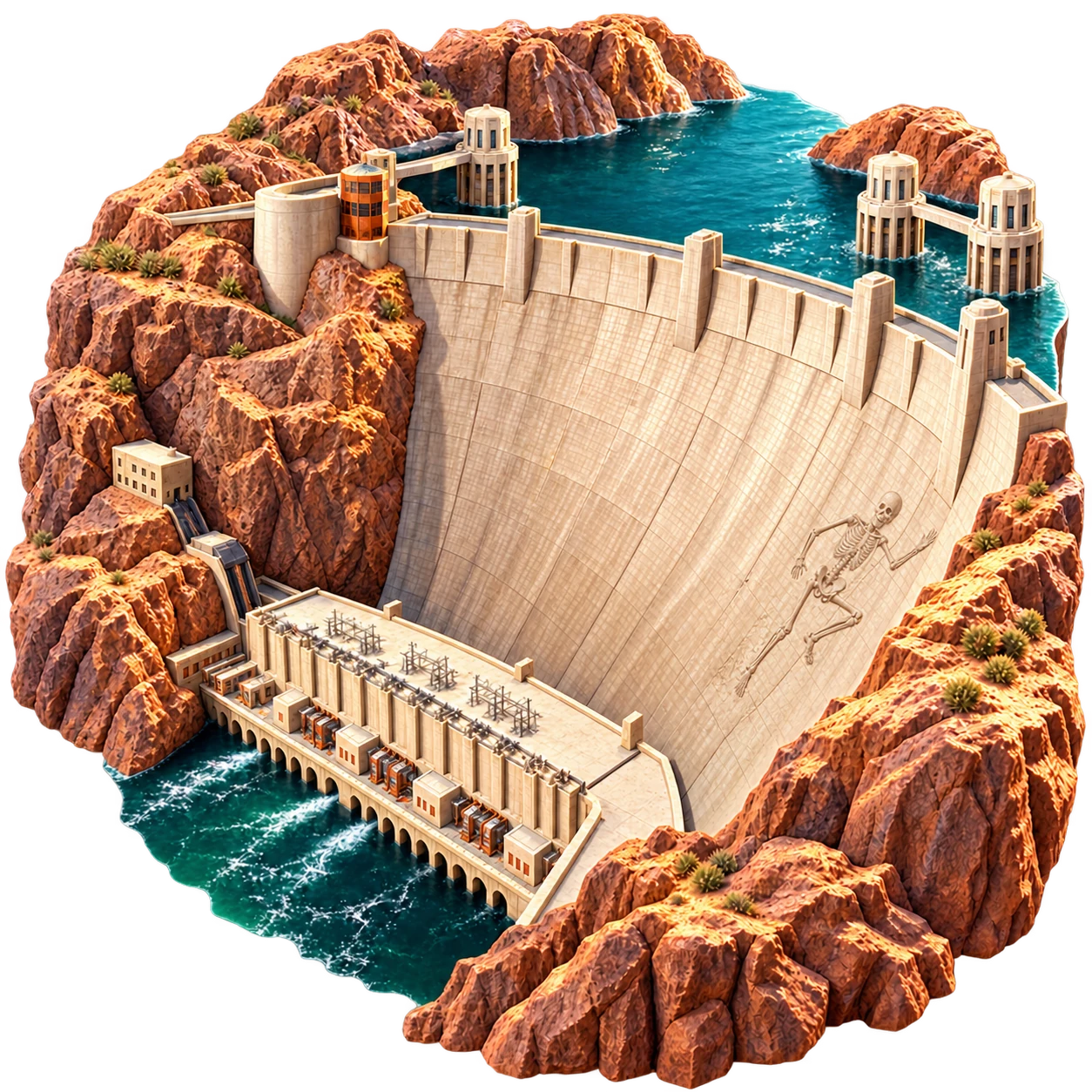
Plot Luck uses an original miniature-style Hoover Dam illustration so players can recognize a vast piece of infrastructure as a tiny point of discovery. The approved map art is a creative interpretation; the game description and this article preserve the documented history.
The in-game marker is intentionally anchored to a publicly accessible Nevada-side memorial plaza rather than the downstream wall, a reservoir edge or a restricted facility. An eligible player's live Real GPS position on that specific map plot can unlock the standard daily Upgrade Token reward. The external discovery link goes to the U.S. Bureau of Reclamation's historical pages—not to a commercial ticket reseller. Simply reading this article does not award tokens.
Hoover Dam represents the ambition, ingenuity and tremendous human labor behind the region's twentieth-century transformation. A wall of concrete. A flood of power. A turning point for the American West.
Sources & further reading
- U.S. Bureau of Reclamation — The Story of Hoover Dam
- U.S. Bureau of Reclamation — Hoover Dam chronology
- U.S. Bureau of Reclamation — construction and employment facts
- U.S. Bureau of Reclamation — Hoover Dam art and memorial plaza
Location and reward eligibility are game design decisions; the historical claims above are drawn from the listed public institutional sources.