 PLOT LUCK
Ice Age Fossils State Park — 25,000 Years Ago
The valley once had marshes, mammoths and predators where neighborhoods and highways stand today.
- History
- Ice Age
- Location
- 8660 N. Decatur Boulevard, North Las Vegas
- In Plot Luck
- Exterior/public approach marker. Confirm plot access and follow posted restrictions.
Is it worth visiting?
- Access / admission
- Nevada State Park; entrance fee applies. Check park opening days and heat conditions.
- Suggested time
- Allow roughly 30–90 minutes; more if you choose longer trails.
What to expect
There are genuine Ice Age discoveries behind the story, with natural-history displays at a relatively small visitor center and full-size prehistoric-animal sculptures outdoors. This is more educational desert park than dramatic skeleton-filled fossil hall.
Before you go
Go expecting interpretation, sculptures and trails—not a huge dinosaur museum or exposed mammoth skeletons along the trail. Stay on paths; collecting fossils or disturbing the landscape is prohibited.
Check official visitor information and updates ↗
PlotLuck editorial visit rating (not a Google review score). Conditions, access and fees may change. Information checked October 17, 2026; verify with the venue before traveling.
When the valley was green
About 25,000 years ago, during the Pleistocene, the northern Las Vegas Valley looked unlike the landscape familiar to present-day visitors. Water and vegetation created marshy habitat that supported large animals. Fossil evidence from the Tule Springs region includes Columbian mammoths, camels, ancient bison, ground sloths and formidable carnivores. These were not creatures from a distant fantasy land: they occupied the valley where people now live, work and drive.
As the climate changed, wetlands retreated and the landscape shifted toward a drier desert ecosystem. Sediments in and around the upper Las Vegas Wash preserved traces of those earlier environments, giving scientists ways to reconstruct changes in water, temperature, vegetation and animal life.
The Big Dig of 1962–63
Scientific interest in local fossils developed during the twentieth century. The ambitious Tule Springs Expedition of 1962–63, often called the Big Dig, brought experts from several disciplines together for a large investigation. Teams examined trenches and fossil-bearing layers, seeking to understand ancient animals and whether the deposits revealed early human occupation. Newer dating techniques helped make the region an important laboratory for understanding the recent geological past.
The researchers did not solve every question. That uncertainty matters: scientific discovery involves changing hypotheses as well as spectacular finds. Later work continued expanding the fossil inventory and improving interpretations of the ancient valley.
A park for a very old story
Nevada designated Ice Age Fossils State Park in 2017 and opened its visitor facilities in 2024. Interpretive trails and a visitor center connect visitors to a landscape that might otherwise look like ordinary dry desert. Life-size megafauna sculpture installations help make the vanished animals easier to imagine, while the museum explains the actual scientific evidence.
This is a protected fossil landscape, not a place to collect souvenirs. Park rules prohibit disturbing fossils, artifacts and natural features. Visitors should stay on designated routes, prepare for desert heat and review current admission fees and hours before traveling.
Why Plot Luck marks it
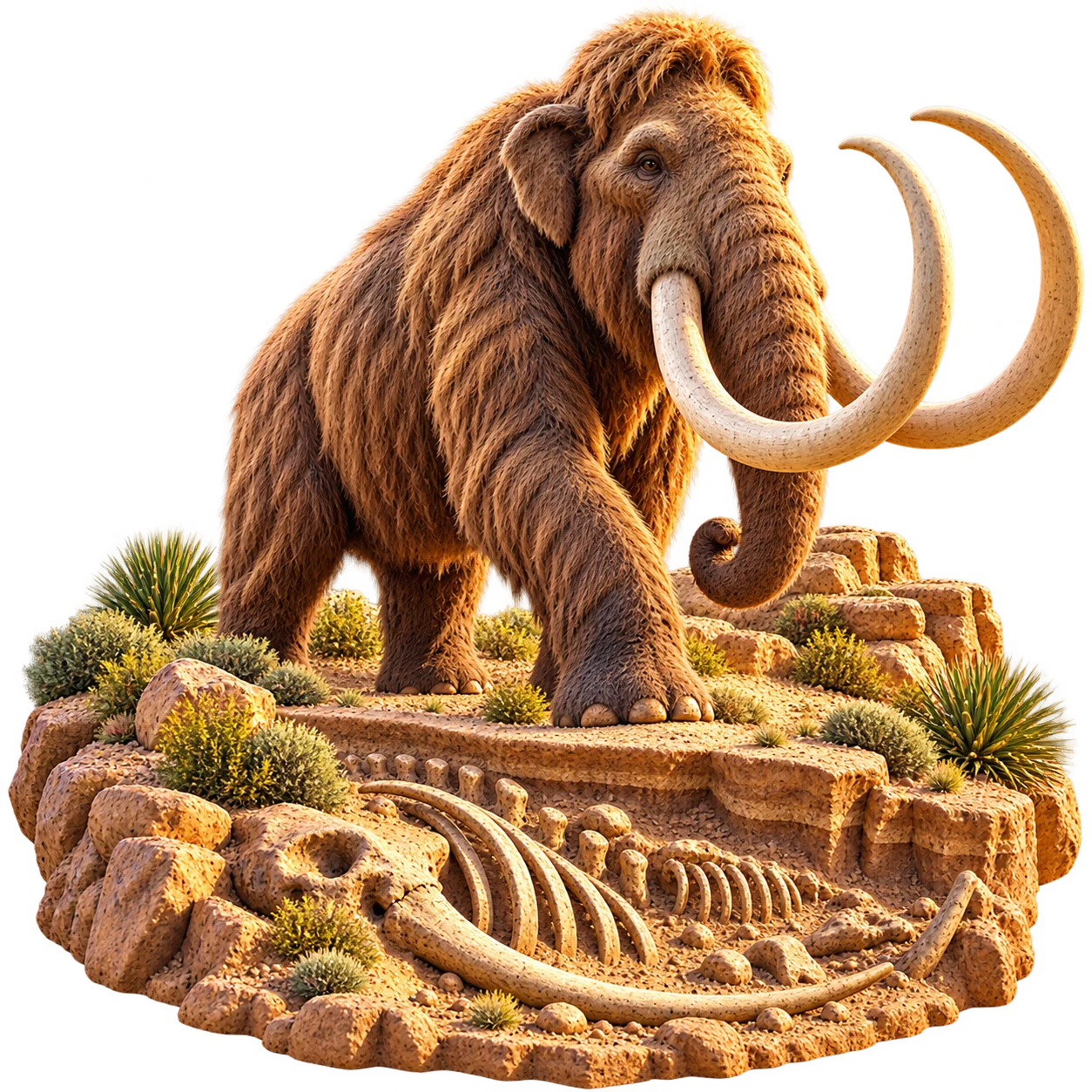
Las Vegas history did not begin with railroads, casinos or the arrival of European settlers. Fossils are an extraordinary reminder that the valley has a much longer natural history. Our mammoth artwork is an original miniature interpretation, not a scientifically exact reconstruction. The game uses an exterior approach plot associated with the park, not a backcountry dig site or restricted fossil trench.
An eligible live Real GPS visit can open Nevada State Parks’ official park page. Returning to Plot Luck can award Upgrade Tokens once per Pacific day, subject to the shared 50-token landmark and Easter egg limit. Reading this article alone does not grant a reward.
Sources & further reading
- Nevada State Parks — Ice Age Fossils State Park
- Nevada State Parks — A State Park 25,000 Years in the Making
- National Park Service — Ice Age Fossils State Park Visitor Center
Artwork is an original stylized interpretation, not a measured reconstruction. The Plot Luck GPS plot represents a historical-site approach and must be confirmed safe and publicly accessible before field rollout.