 PLOT LUCK
U.S. Post Office and Courthouse — 1933
Long before it became the Mob Museum, this neoclassical federal building helped Las Vegas connect to the rest of the country—and later became a stage for one of the city's most famous hearings.
Is it worth visiting?
- Access / admission
- The Mob Museum is ticketed; check current hours and exhibitions.
- Suggested time
- Allow roughly 2–3 hours for a museum visit.
What to expect
The former federal courthouse is itself part of the story, and the museum adds extensive exhibits about organized crime and law enforcement. It is an unusually strong example of a historic building getting a second life as an immersive visitor experience.
Before you go
Plan time for the exhibits rather than treating this as an exterior courthouse photo. Check tickets and available experiences on the museum’s official site.
Check official visitor information and updates ↗
PlotLuck editorial visit rating (not a Google review score). Conditions, access and fees may change. Information checked October 17, 2026; verify with the venue before traveling.
A federal landmark for a growing town
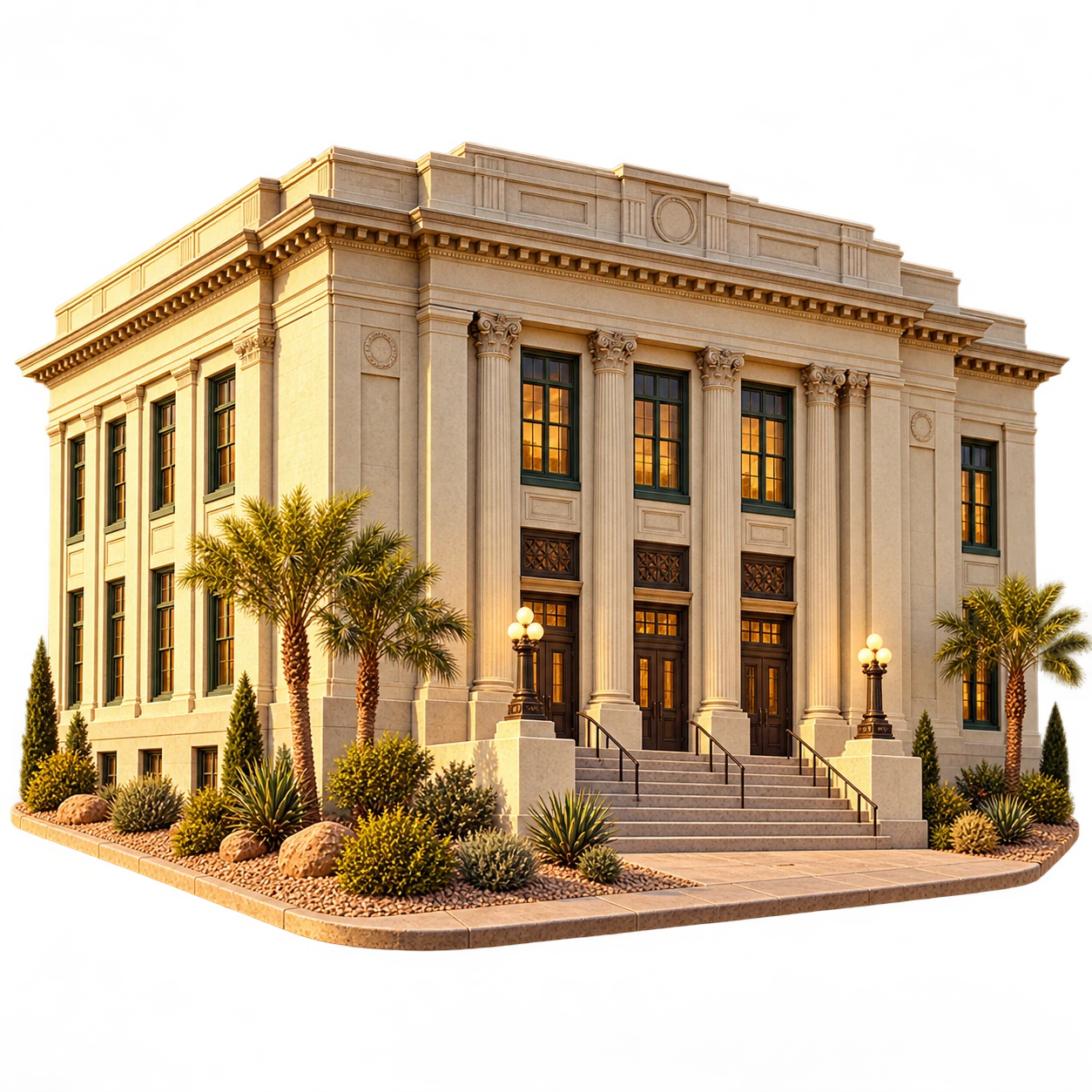
When the U.S. Post Office and Courthouse opened in 1933 at 300 Stewart Avenue, Las Vegas was still a relatively small city. Yet the new building projected a very different future. With its symmetrical façade, tall classical columns, and durable stone-like exterior, the structure announced a stronger federal presence in Southern Nevada. It handled ordinary needs like mail, but it also housed courtrooms, offices, and the legal machinery of the United States government.
Architecturally, the building reflects the neoclassical style commonly used for civic and federal buildings in the early twentieth century. That design language mattered. A courthouse was not meant to look casual or temporary. It was meant to communicate order, seriousness, and permanence in a desert town still defining itself.
Why this building matters in Las Vegas history
Las Vegas has many famous addresses, but most of them are tied to entertainment, gambling, or tourism. The former post office and courthouse represents something different: government, law, and the public institutions that grew alongside the city's commercial image. It is one of the older surviving public buildings in Las Vegas and a rare downtown landmark whose importance does not depend on a resort brand.
That also makes it a useful counterweight in Plot Luck's landmark collection. Not every story about Las Vegas has to point to a casino floor or a neon sign. Some of the city's most revealing history took place in classrooms, courthouses, post offices, and meeting rooms where people argued about how the city should function.
The Kefauver hearings and organized crime
In 1950, the building gained national historical significance when Senator Estes Kefauver's Special Committee to Investigate Organized Crime in Interstate Commerce held hearings here. Those hearings helped expose how organized crime had influenced gambling and public life in multiple American cities, including Las Vegas. The restored courtroom remains one of the building's defining spaces.
The hearing did not magically transform the city overnight, but it became part of the story of how Las Vegas was seen by the wider nation. The building therefore stands at the intersection of local life and national attention: a place where mail moved, court business unfolded, and the mythology of Las Vegas met the hard realities of law enforcement and public scrutiny.
From federal building to Mob Museum
Decades later, the historic structure found a new life as The Mob Museum, officially the National Museum of Organized Crime and Law Enforcement. That adaptive reuse preserved the building itself while giving it a purpose closely tied to one of the stories that had already unfolded inside it. Instead of treating the courthouse as an empty relic, the museum made the building part of the exhibit.
This later chapter is important in its own right. Preservation is not only about freezing a place in time; it is also about finding a future use that respects the past. The courthouse remains legible as a 1933 federal monument even while serving modern museum visitors.
What to notice on a visit
Stand back from the building and notice the confident geometry: the raised entry stair, the formal central bays, the columned front, and the disciplined arrangement of windows. These details help explain why the structure reads differently from the hotels and storefronts around it. Look for the way landscaping and the corner lot frame the building as a civic object rather than a commercial façade.
Plot Luck's map art is an original, stylized miniature interpretation created for discovery at map scale. The in-game reward anchor uses a public exterior plot near the building, not a paid interior admission area. Use ordinary public sidewalks and entry points, and respect current operating rules if you choose to visit in person.
Why it belongs in Plot Luck
The U.S. Post Office and Courthouse helps tell a fuller Las Vegas story. It connects architecture, civic life, federal history, the Kefauver hearings, and the city's later effort to preserve an important downtown structure.
In the game, an eligible live Real GPS visit can unlock The Mob Museum's official fact sheet page. Returning to Plot Luck may award Upgrade Tokens once per Pacific day, within the shared 50-token daily limit for landmarks and Easter eggs. Reading this article alone does not grant a reward.
A federal building. A famous hearing. A downtown landmark that still tells the story.
Sources & further reading
- The Mob Museum — Fact Sheet
- The Mob Museum Digital Archive — This Building of Ours
- The Mob Museum — Official site
The in-game artwork and reward location are a creative presentation of documented history, not an exact architectural reconstruction or a guarantee of site accessibility.